Breadth
Substantive knowledge or work across distinct fields. We group related activities together: several jobs, awards or projects within one profession do not automatically become several disciplines.
 POLYMATH NEXUSCONSULTANCYRegister
Polymath Nexus Consultancy presents
The Digital Era and the Inevitable Rise of the Polymaths
Join five speakers online on 14 November 2026, 2:00–5:30 PM Malaysia time, to explore polymathy across healthcare, education, technology and institutions—and turn a wider view into practical action.
 Distinct minds.
Why this gathering
We gather because the freedom to know more should become the capacity to do more good.
Global digitalisation has opened an extraordinary gateway to human knowledge. Yet the same channels carry wisdom and distortion, opportunity and distraction. Access to information is growing faster than the guidance that helps people judge it, connect it and use it responsibly.
Drawing on his systems thinking and exploratory scenario simulations, founder Shahir Anuar Bin Shahrani anticipates that many in this digital generation will be less bound to the occupational pathways inherited from earlier generations. He offers this as a founder’s perspective on possible futures, rather than a measured forecast: when people can discover new fields and choose what moves them, a life’s work may become a constellation rather than a single track.
Our response should be guidance rather than alienation. We can help emerging minds develop depth without closing off their range; autonomy without losing responsibility; and ambition that remains connected to human needs. This gathering brings disciplines together to show how curiosity can mature into competence, and how competence can become service.
Polymathy matters here because it gives connection a purpose. The task is not merely to know more, but to discern what deserves our attention, bring different kinds of knowledge into conversation, and build a future in which more people can contribute.
Understanding polymathy
First examine the work. Then describe its range, its connections and how it developed over time.
01 · What qualifies the work?
For our seminar’s portfolio assessments, a substantive polymathy case needs all three dimensions. This follows the breadth–depth–integration approach developed in Michael Araki’s research; it is a framework for examining work, not a professional licence or a universal pass–fail test.
Substantive knowledge or work across distinct fields. We group related activities together: several jobs, awards or projects within one profession do not automatically become several disciplines.
Sustained competence supported by practice, qualifications, responsibilities or completed outputs. We ask what was actually done, at what level and with what evidence; an interest alone is insufficient.
A demonstrable connection between fields: a method, idea or skill from one changes the work in another. A list of unrelated credentials needs examples of how the knowledge is used together.
A specialist contributes depth; an interdisciplinary practitioner integrates fields. A wider polymathy claim also needs substantive breadth. There is no agreed universal number of degrees, an IQ threshold or a count of profile boxes that settles the question.
Araki & Cotellessa (2020), criteria and the general construct of polymathy ↗02 · How does it unfold?
Substantive work in different fields overlaps in time. Dated outputs or responsibilities help establish the overlap.
Work moves between fields over successive career phases. Earlier knowledge may inform later work even when active commitments change.
A career can combine both patterns. Incomplete dates support a cautious description rather than an assumption that every activity is current.
Root-Bernstein and Root-Bernstein’s Life Stages of Creativity (2011) describes multiple creative-career trajectories. Araki and Cotellessa (2020) also discuss polymathic activity across a lifetime.
“Proper” and “simultaneous” answer different questions here. We use proper to mean a substantive case meeting the three criteria; simultaneous describes its timing. Serial polymathy can also meet the criteria.
Root-Bernstein & Root-Bernstein (2011), life-stage patterns ↗03 · The Polymath Spectrum
Angela Meyers proposes six descriptions of development. They are a reflective model, not a validated test, a required progression or a measure of intelligence. The summaries below follow her six stages; this site's Systemic-T shorthand is a separate editorial description.
Wide curiosity exists, even when circumstances have not yet allowed it to develop openly.
Explores multiple fields and begins connecting interests while looking for a coherent practice.
Sustains work and self-directed learning across fields.
Translates between domains and makes useful connections across their boundaries.
Shapes environments and organisations so others can think and work together on complex questions.
Contributes models or frameworks that reframe a field or persist beyond their creator. Long-term influence matters to this description.
These are Meyers’s proposed stages, not credentials awarded to symposium members. An architect-oriented project can be described from its current tools and structures while its lasting influence remains unproven.
Angela Meyers, “Polymathy Exists on a Spectrum” ↗Read the speakers’ individual assessments ↗Read the numbered work points and their underlying records. Distinguish completed work from proposals, dated responsibilities from past posts, and independent records from supplied professional information. These are editorial portfolio assessments by Polymath Nexus Consultancy, not independent accreditation. AI-generated descriptions and Mensa membership are not used as proof of the three criteria.
A polymathic firm can combine complementary specialists and integrators. The firm’s breadth does not automatically establish every member’s individual polymathy.
Araki (2026), definitions and distinctions ↗01 · What the word means
A polymath develops substantial knowledge or skill in more than one field and connects that learning in useful work. Range alone is not the point: the defining move is bringing ideas, methods or experience from different fields together.
Polymathy is not a fixed number of degrees, a claim to know everything, or a synonym for being clever. It can describe an individual who works across disciplines, or a team whose members combine distinct areas of expertise around a shared problem.
02 · History in the making
Polymaths stand among history’s great agents of transformation. Their distinctive strength is synthesis: joining knowledge that others keep apart, seeing possibilities between disciplines, and turning those connections into new tools, institutions and ways of thinking.
| Group | Core trait | Historical contribution | Context and limits |
|---|---|---|---|
| Polymaths | Substantial knowledge across fields, brought together through synthesis. | Transformative and field-building. They connect discoveries, methods and cultural ideas to open new directions in human thought and practice. | Breadth must be sustained by depth, execution and collaboration. |
| Scientists | Systematic inquiry, experimentation and explanation. | Foundational. Scientific work expands reliable knowledge and the understanding on which medicine and technology depend. | Progress depends on available evidence, methods and tools; scientific work can also be polymathic. |
| Specialists | Deep expertise in a defined domain. | Essential to precision and scale. They refine ideas into dependable practices, technologies and infrastructure. | Strong focus benefits from exchange with other disciplines when a challenge crosses boundaries. |
| Professors | Scholarship, teaching and institutional research. | Generational. They preserve, challenge and transmit knowledge, developing the people who carry it forward. | Institutional roles vary; a professor may also be a specialist, scientist or polymath. |
| Geniuses | Exceptional originality, intellectual ability or creative achievement. | Potentially revolutionary. Original insights and masterworks can redirect a field or culture. | The term is debated; enduring impact depends on what is created, applied and shared. |
| Savants | Exceptional ability in a specific area, within a particular developmental or acquired profile. | Distinctive individual contributions, including in art, music, memory and calculation. | A clinical description does not determine a person’s worth or impose a universal ceiling on their contribution. |
History changes when knowledge crosses a boundary. Leonardo da Vinci brought artistic observation into anatomy and engineering. Ibn Sina connected medicine and philosophy; Aristotle wrote across logic, biology, ethics and politics; Benjamin Franklin joined scientific inquiry, invention, writing and public life. These examples make the affirmative case for polymaths as architects of historical change: they can reveal relationships that a single disciplinary view may miss. Scientists, specialists and educators then deepen, test, transmit and scale new possibilities. Polymathy is therefore central to our story because synthesis can turn separate advances into a wider transformation.
The categories overlap. This is a comparison of contributions and an argument for the importance of synthesis, rather than a numerical ranking of people or an established measure of all historical impact.
03 · The Polymath Spectrum
Angela Meyers describes six ways polymathic capacity may develop, including integration, collective leadership and long-term field-building. This is her proposed spectrum, not a credential or compulsory progression.
Wide curiosity may be present before a person has a supportive way to develop or express it.
Explores fields and begins finding connections between interests.
Sustains learning and creative work across domains.
Translates between fields and joins methods in useful work.
Shapes conditions in which others can combine knowledge and act together.
Contributes frameworks or models that may reframe a field and prove durable over time.
These six stages reflect Meyers’s proposed, non-linear model. Systemic-T is this site’s separate shorthand for systems-oriented practice, not one of her named stages. A member’s architectural work can be assessed from built tools without claiming that its influence will outlast its creator. Read Meyers’s article ↗
04 · History and examples
Polymathy did not begin on one date. The word is often associated with Renaissance figures in popular accounts, but scholarship also studies people and knowledge traditions that connect fields in earlier and different cultural settings.
The medieval physician and philosopher wrote across medicine, logic and philosophy, and worked to connect strands of scientific and philosophical thought.
Stanford Encyclopedia of Philosophy ↗The Renaissance artist also studied and designed across engineering, architecture, mechanics and anatomy—an enduring example of observation moving between art and inquiry.
MacTutor History of Mathematics ↗Historical work is examining how disciplines interacted in premodern Islamic intellectual cultures. This reminds us that modern subject boundaries should not be projected unchanged onto every era.
European Commission CORDIS project ↗These examples illustrate different forms of wide-ranging work; they are not a ranking. The history of polymathy is still being studied across cultures and periods.
05 · Why it matters
A health service, an education system or an AI policy is shaped by more than one kind of knowledge.
Take a public-health question: clinical evidence, community trust, data, staffing, technology and service operations may all affect the answer. No single person needs to master every part. The work needs clear specialists—and people able to connect their contributions around the same human problem.
The National Academies describes interdisciplinary work as integrating specialised knowledge when a question or solution exceeds the scope of one field. That is the practical case for polymathic thinking: it can help us notice dependencies, ask better questions and build useful collaborations.
National Academies, Facilitating Interdisciplinary Research ↗
06 · How to develop polymathy
Polymathy grows through deliberate learning and applied work. It is more than collecting interests or credentials.
Build real competence and respect the evidence, ethics and standards of your home discipline.
Study one neighbouring subject at a time. Ask how it frames problems, uses evidence and decides what counts as a good answer.
Use a practical project to connect ideas: improve a process, teach a concept, test a tool or examine a service challenge.
Explain the connection in plain language, check assumptions with evidence, and invite specialists to challenge your interpretation.
Notice what transferred, where your knowledge ends, and whose expertise is needed next. Give credit and keep learning.
07 · Why the idea is rising
As technology and institutions touch more parts of everyday life, many important questions involve human, technical and organisational consequences at once.
A 2005 National Academies report identified the complexity of nature and society, societal problem-solving and new technologies among the drivers of interdisciplinary research. The point is not that every challenge needs a polymath. It is that more challenges call for people who can work across boundaries while staying grounded in expert knowledge.
That is why we speak of an “inevitable rise”: as a direction of work to prepare for, where deep expertise is joined by curiosity, communication and collaboration. It is a guiding thesis for this symposium, not a numerical forecast.
08 · From specialisation to polymathy
The shift we hope to encourage is from specialisation alone to specialisation connected.
People can keep a strong professional home while learning to translate across fields, move between questions and collaborate with others whose knowledge is different from theirs. Some will build that range within one career; others will do it together as a team.
We use “a generation moving slowly from specialisation to polymathy” to describe this aspiration. It does not mean specialists are becoming unnecessary or that every young person is following the same path. It means making room for depth and connection in the same future.
Founder’s vision
“If consciousness is only perception, the world remains a spectacle. If it is only intelligence, the world becomes a puzzle to be solved. But if consciousness matures into morality, the world becomes a bond—a claim upon us, and we upon it.”— Shahir Anuar Bin Shahrani
Our mission
We use our gifts to help people, create value, and empower SMEs and institutions.
We accept sacrifice today for the benefit of those who come after us.
Our approach
We help teams frame complex challenges, connect relevant expertise and examine how people, evidence, technology and services interact.
Clarify the problem, the people affected and the outcome you need. Look at the surrounding system before settling on a solution.
Draw on the disciplines relevant to the challenge. Examine how evidence, operations, technology and human needs influence one another.
Explore options, surface trade-offs and test assumptions. Use a focused prototype or review where it can resolve uncertainty.
Set out priorities, responsibilities and useful measures of progress. Define an engagement around the work and expertise actually needed.
The idea in practice · Polymath Nexus Consultancy
Our firm combines specialisations into one coordinated practice.
Polymath Nexus Consultancy is polymathic by design: it brings together people and capabilities across strategy and innovation, systems and technology, health and public systems, education and human potential, and people and institutions. We connect those perspectives around the challenge a client needs to solve.
This describes how the firm works; it does not claim that every consultant is an expert in every field. Specialists keep their depth. Our shared method helps the right expertise meet, understand how the parts affect one another and shape a practical next step.
Meet the speakers
Each speaker’s linked assessment examines breadth, depth, synthesis and work over time. Descriptions reflect the available evidence: a polymathic team can include both polymaths and specialist-led integrators. Open the assessment to see the conclusion, supporting records and limits.
His documented portfolio spans pharmacy practice and research, medicine-device design, digital health, publishing, education, advising and institutional service. The record includes both concurrent work and projects developed in sequence.
The available record shows sustained pharmacy practice alongside applied technical creation, completed creative publishing, advisory work and institutional service. Its breadth sits alongside depth in pharmacy; its synthesis appears where a clinical need becomes a device or digital tool, a concern for inclusion becomes a story and learning resource, and people with different expertise are brought together around a challenge. The dates show both current strands running in parallel and projects developed in sequence, so the record is best understood through the work, its connections and its timing.
His work joins clinical care to public-health programmes, disease surveillance, service improvement and community communication.
Public Health & Healthcare Leader · Master of Public Health (UM) · Chartered Islamic Finance Professional (INCEIF)
The strongest positive case supported by the record is to identify Dr Imran as a Serial Integrative Clinical–Public Health Polymath. His documented career progresses from rural clinical leadership into divisional public-health operations and further research training, connecting individual care with population programmes, surveillance, quality improvement, health communication and community learning. The serial label describes the best-supported timing across those career phases; clinical care, coordination, outreach and communication also overlapped within particular roles. This recognises substantial cross-disciplinary work across health and public systems without claiming that every strand was active concurrently or that he has equal depth in unrelated fields.
Her work links people and organisational knowledge with academic leadership, programme design and institutional assessment.
The strongest positive reading of the record is a Simultaneous Integrative Institutional-Humanist Polymath. Dr. Zabeda’s work connects psychology and human-resource scholarship with knowledge management, education, executive development and the design and review of institutions. This is supported by long-term academic work, funded research, doctoral supervision, international programme leadership and repeated accreditation assessment. Dated records show research and teaching overlapping with executive learning and external accreditation, so simultaneous is supported by documented concurrent strands rather than inferred from a long list of past titles.
Her work connects computing and problem-solving with educational design, teacher development and student learning.
The strongest positive interpretation is a Simultaneous Integrative Education–Technology Polymath. The record documents substantial work in both information technology and education: two doctoral qualifications, computational-thinking and computer-science training, curriculum consultation, teacher development, digital-economy consultancy, authored learning materials and an education enterprise. Her defining contribution is the sustained translation of computing into teaching methods, curricula and learner projects. The supplied profile presents these education and technology strands as concurrent professional practice; fuller role dates would make the overlap easier to independently audit.
His work links engineered and AI systems with governance, sustainability, accessibility and youth participation.
The strongest positive case is a Simultaneous Integrative Socio-Technological Polymath. Liam’s portfolio links mechatronics and AI engineering with governance, environmental and accessibility challenges, youth education and social organisation. The record includes a university-documented wildfire-detection project, accessible-technology work, contributions to AI-governance frameworks, a youth sustainability organisation and extensive mentorship. His strongest technical depth is complemented by growing policy and community practice. Current roles across technology, governance and youth work support a concurrent classification; earlier awards are treated as milestones, not proof that every project remains active.
Saturday · 14 November 2026
Online Zoom Meeting · 2:00–5:30 PM Malaysia time. Joining instructions will be sent to registered participants.
CPD: 3 points for full attendance, subject to approval by the relevant professional body and its attendance requirements.
Shahir Anuar Bin Shahrani introduces polymathy, Polymath Nexus Consultancy, the Founder’s Vision and the Company’s Mission.
A keynote on connecting ideas across pharmacy, technology and community needs to develop practical social innovations, followed by audience Q&A.
A keynote exploring how multidimensional thinkers contribute in life and the workplace, followed by Q&A.
Five-minute break between speakers.
A keynote on creative problem-solving and gifted digital talent, followed by Q&A.
Five-minute break between speakers.
A keynote on ethical AI governance, federated learning and assistive technology for social good, followed by Q&A.
Five-minute break between speakers.
A keynote on public-health operations, quality improvement and community outbreak resilience, followed by Q&A.
Five-minute break before the final discussion.
All five members join the final question-and-answer forum.
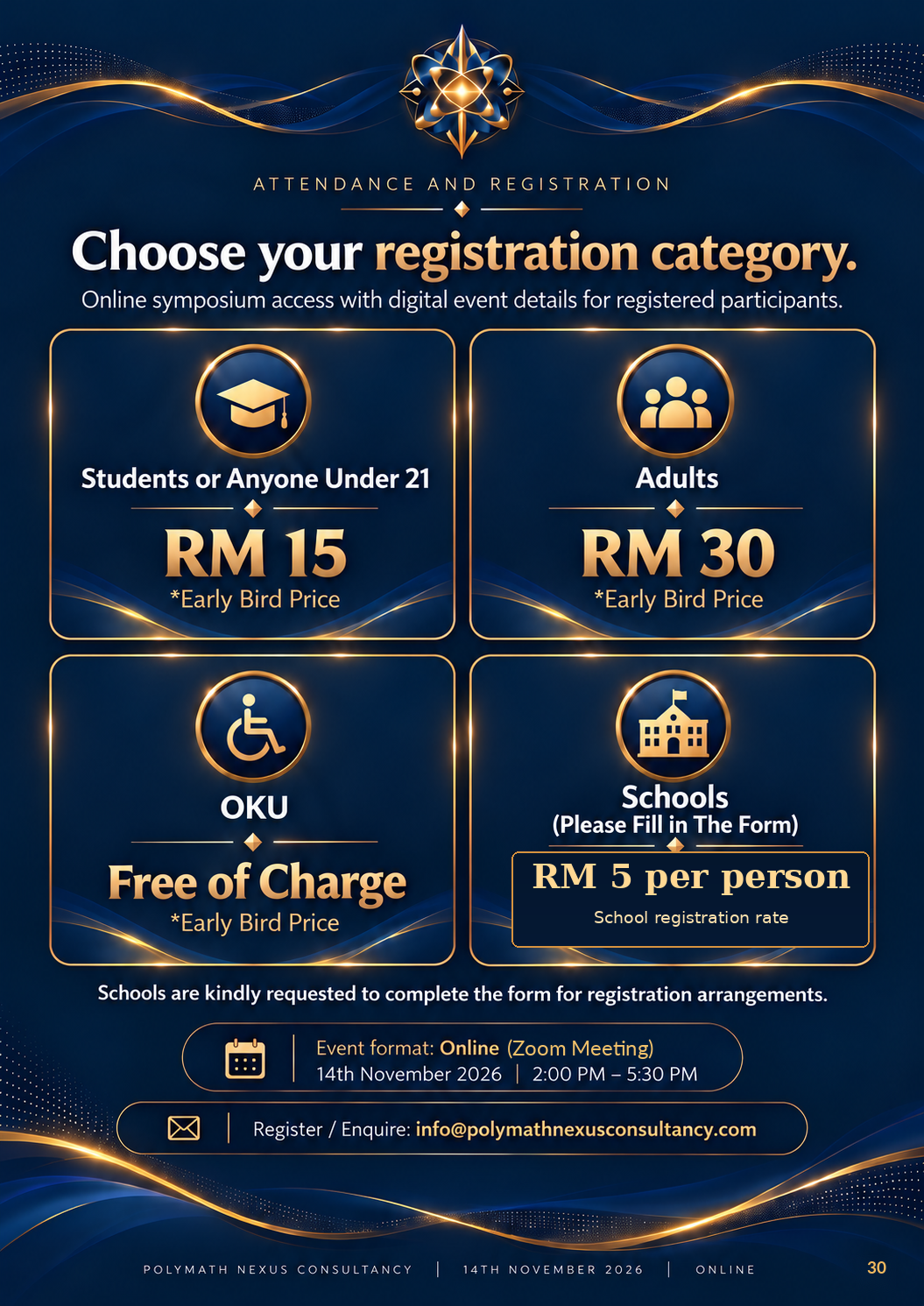
Online admission · Limited seats · 50+ slots left
Early bird prices are available through 6 November 2026. Zoom joining instructions will be sent to registered participants. Scan the Stripe payment QR; choose the matching category and quantity at checkout.
Pay securely with Stripe
Scan the QR code and choose the matching category and quantity at checkout. OKU registration is free; please use the registration form.
 Unable to Scan? Click here
Seats are limited. Selling out fast. Only 50+ slots left.
Meet online
Saturday, 14 November 2026
2:00 PM–5:30 PM Malaysia time
Zoom joining instructions will be sent to registered participants after registration.
Use the registration form with payment reference MPS2026. Schools should submit participant details and quantities in the form.
Open the registration form ↗The Inevitable Rise of the Polymaths
The navy-and-gold brochure includes the updated online programme, registration categories and a final payment QR page. Interactive sections appear as normal readable content.